
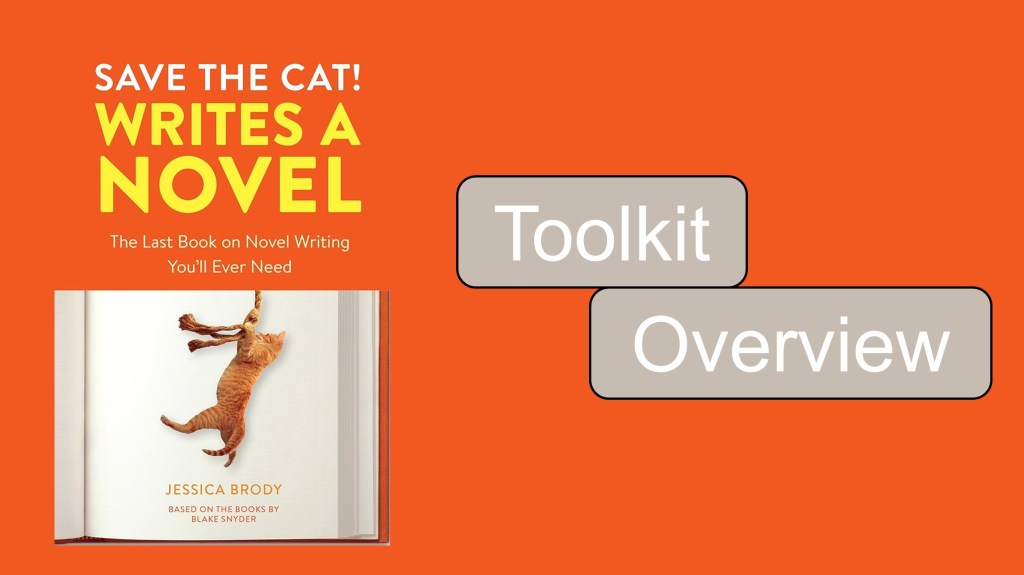
As mentioned previously, I’ve taken some time after Infinitude’s release to hone my skills around storytelling, character building, and structure. I always like to take classes and read how-to books here and there, so this break has been insightful and I’m excited to use the tools I’ve learned in future projects.
In case you missed it, my first overview can be found here for the writing help guide, Story Genius.
This newest guide called, Save the Cat! Writes a Novel (silly name, but there’s a reason for it) is a truly phenomenal guide by Jessica Brody. Originally a concept designed for screenplays, she has taken those tools and translated them for novel writing, while also bringing a host of examples (so many…it’s impressive) that bring her tools to life. I absolutely loved my time with this guide and would recommend this and Story Genius as a powerful 1-2-punch for any aspiring writer. Rather than list my main takeaways like in the previous blog, I decided to do something a bit different and instead give a brief overview of the tools Brody provides you.
The Beat Sheet
First up is a kind of crazy “formula” that Brody proposes all stories follow more closely than you might presume. And while formula may scare some, it’s not so locked-in that it makes your story boring. As I’ve spent time looking at films, books, etc. since reading this, I’ve come to the realization that she’s right! Below is how many stories play out (with some wiggle room here and there). I’ve also made the distinction if the “beat” is a single scene or a multi-scene one.
- Act 1
- Opening Image – single
- Theme Stated – single
- Setup – multi
- Catalyst – single
- Debate – multi
- Act II
- Break Into Act 2 – single
- B Story – single
- Fun & Games – multi
- Midpoint – single
- Bad Guys Close In – multi
- All is Lost – single
- Dark Night of the Soul – multi
- Act III
- Break Into Act 3 – single
- Finale – multi
- Gather the Team/Tools
- Executing the Plan
- High Tower Surprise
- Dig Deep Down
- Execution of New Plan
- Final Image – single
There’s much more context Brody provides for each of these bullets in not only impressive detail, but tied to specific examples of books you’ve likely read. The Beat Sheet tool aims to simplify your storytelling decision making, while creating a well-paced, engaging read. The book is worth it for this content alone.
Genre Types + Must Haves
As a compliment to the Beat Sheet, Brody contends that there are 10 specific genres, each of which have their own “spin” on the Beat Sheet in the form of Must Haves. Similarly, I found these incredibly helpful as the broad definitions leave just enough room for nuance and creativity while also impressively detailing many common stories to a specific genre.
Below are the 10 Genres that Brody outlines, with a few examples highlighting their must haves:
- Whydunit
- Rites of Passage
- Institutionalized
- About the many and the protagonist’s relationship with that group. Must have:
- Group
- Choice
- Sacrifice
- About the many and the protagonist’s relationship with that group. Must have:
- Superhero
- Dude with a Problem
- About an ordinary person against extraordinary circumstances. Must have:
- Innocent Hero
- Sudden Event
- Life or Death Battle
- About an ordinary person against extraordinary circumstances. Must have:
- Fool Triumphant
- Buddy Love
- Out of the Bottle
- Golden Fleece
- Roadtrip-esque. About the journey, not necessarily the destination. Must have:
- Road
- Team
- Prize
- Roadtrip-esque. About the journey, not necessarily the destination. Must have:
- Monster in the House
Hero Creation
Surprisingly, this portion – the shortest of Save the Cat!‘s various blocks – was the only component that felt like true overlap with Story Genius. It’s part of the reason I enjoyed both of these guides so much…my initial worries of their Venn Diagram of information being too overlapping was unfounded. And while Story Genius arguably does this tool “better” (because it’s what the entire book is about), Save the Cat! does a good job reinforcing the message.
Less of a list, this portion forces you to ensure your hero has a Problem/Flaw, a Want/Goal, and a [unknown] Need/Life Lesson. It encourages you to make your protagonists and their lives messy…the more chaotic, the better and more engaging. It wants you to ID their “Shard of Glass”…the festering problem that has been in their lives and how they need to be rid of it (even if they don’t know it yet).
Lastly, it encourages you to determine some themes of your story and protagonist’s journey, citing that almost all stories hit on some universal theme like forgiveness, love, acceptance, faith, fear, trust, survival, selflessness, responsibility, or redemption.
If you are a writer and like me where “continuous improvement” is something you enjoy and take seriously, I encourage you to seek these helpful books out and go through them slowly, taking notes and potentially even applying them to an upcoming project. I know I’ll be doing the latter – hopefully soon – and I can’t wait to see the impact it has on my writing.

 J. T. Rath
Leave a reply to From Ideas to Novels: My New Writing Process – J. T. Rath Cancel reply